
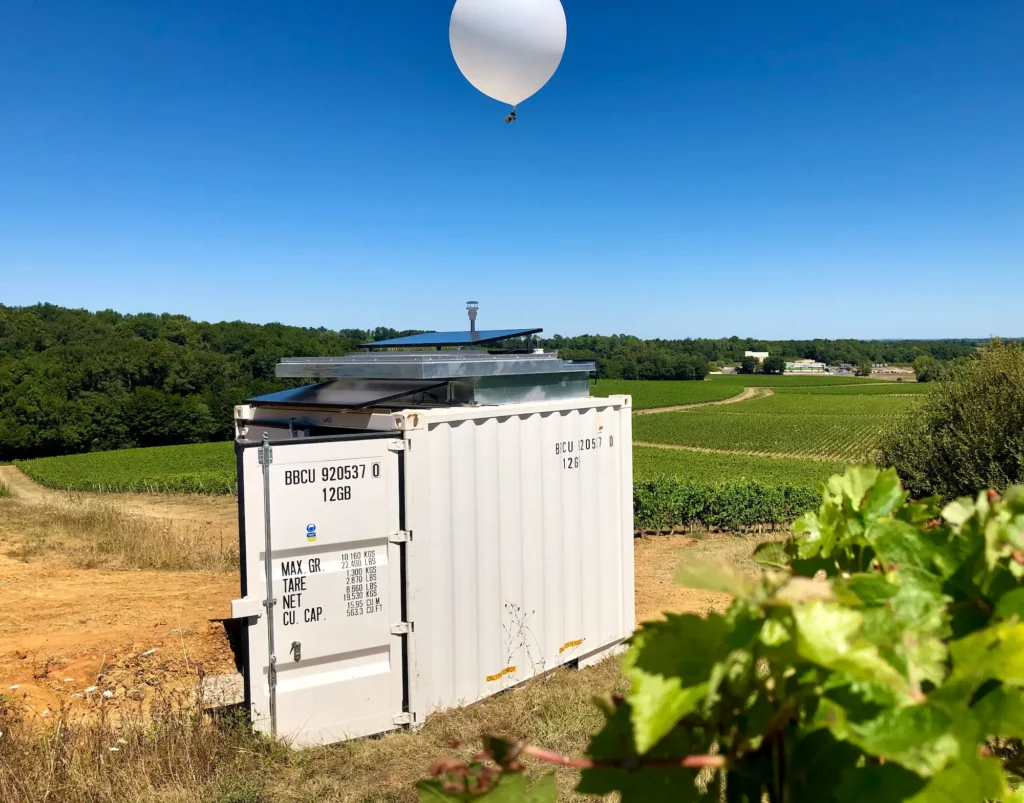
LAICO is SELERYS's patented smart cloud seeding balloon solution. It launches by remote command, without pre-flight authorization, and climbs with GPS tracking to its target, where it releases its seeding agent.
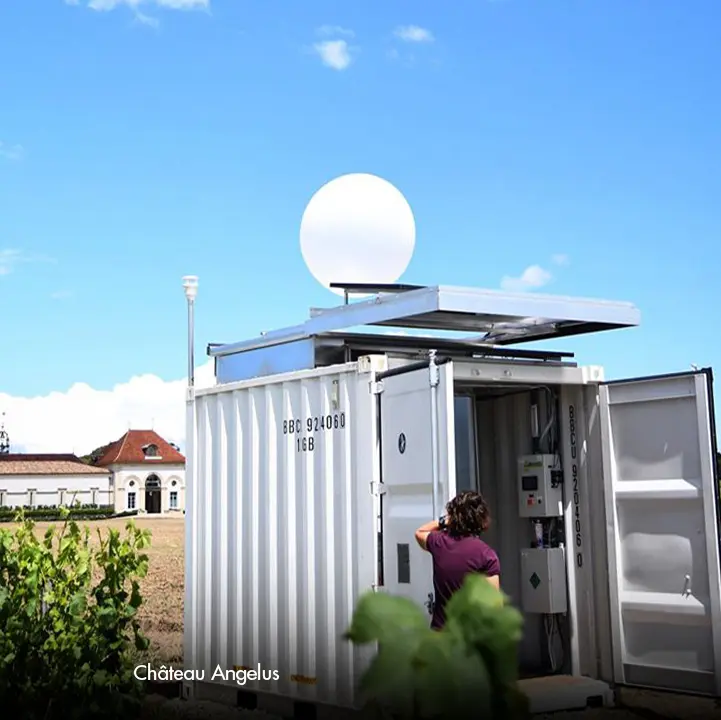
A LAICO cloud-seeding balloon can be launched from a SOBLI (Self-Operating Balloon Launcher Instrument) station using a command sent by SMS or web. CIRRUS software checks the flare’s safety system, transmits the flight plan (ignition rules based on embedded met sensors & algorithm), and inflates the balloon with 1.2 m³ of helium. The flare carries up to 500g of hygroscopic salt or silver iodide and ignites once the balloon reaches its target.
In flight, the balloon transmits its GPS position and radiosounding readings in real time back to CIRRUS, building a complete vertical cloud profile in a single flight. Each solar-powered SOBLI launch station keeps up to 24 LAICO balloons pre-loaded and can release up to 6 simultaneously, allowing a fast response to a seedable cloud situation.
LAICO SOBLI at a Glance
- Remote launch by SMS or web, no technician needed
- CIRRUS builds a full vertical read of the cloud from a single ascent, cutting out the multiple passes an aircraft needs
- A single station holds 24 balloons, enough for several launches during one storm
- No systematic flight clearance needed: LAICO's patented design operates under a Full Freedom to Operate agreement with civil aviation authorities
Cloud-seeding Balloon or a Drone: what to choose
SELERYS offers cloud seeding through both balloons and drones. But where icing, severe turbulence, darkness, or mountainous terrain ground a drone or a plane, a LAICO balloon climbs on updrafts and reaches the heart of a cloud regardless of conditions.
Although SELERYS‘ mission manager makes it autonomous, a drone still needs a certified pilot on-site, regular battery maintenance, and constant in-flight supervision. In contrast, a manned aircraft needs a licensed pilot and flight clearance before every launch. By contrast, the smart LAICO balloon is fully autonomous from launch.
Advantages of Balloons
- Cloud-seeding balloons can launch correctly around the clock, even at night, when a drone operator loses the visual line of sight
- A LAICO SOBLI network can target all the seedable cells within the target area, while a plane works on only one moving target per mission
- LAICO eliminates personal risk associated with sending a pilot over a storm cell or mountainous terrain
- Between 800 and 1,200 meters, where a cloud’s warm phase can be triggered into early rain, LAICO handles the mission with precision that an aircraft can’t deliver
- SELERYS‘ balloons operate at around 5 m/s, which an independent German study found to be the optimal dispersal speed for cloud seeding.
Coverage, Capacity, and Efficiency
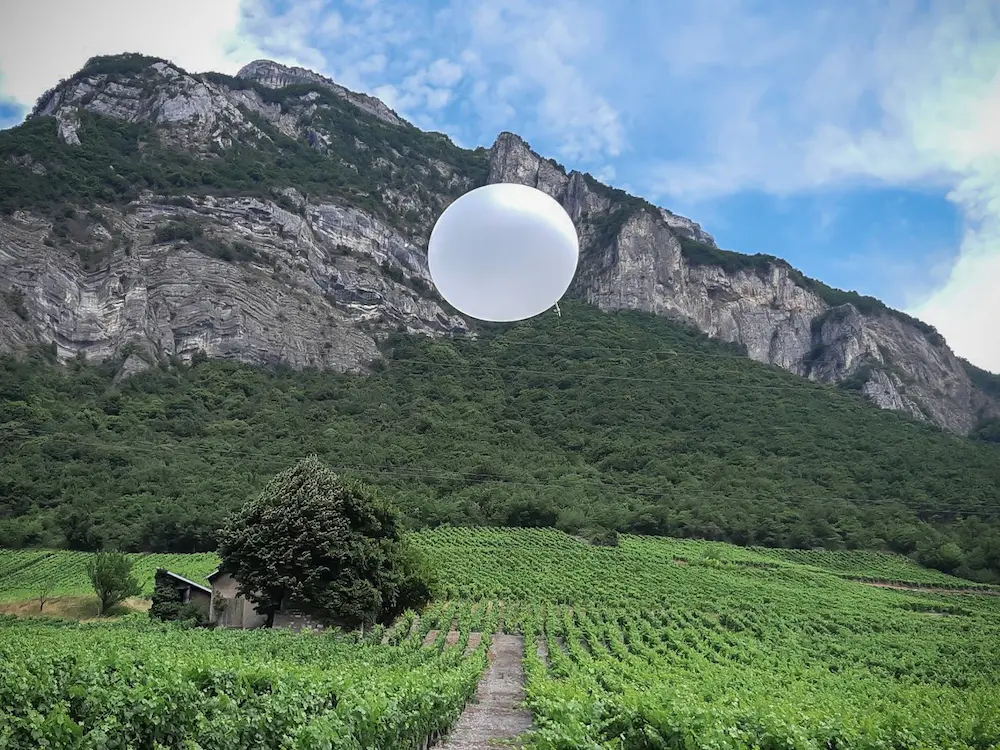
A single LAICO balloon by SELERYS can treat an area of sky equivalent to about three football stadiums.
Traditional radiosounding balloons are single-use and tracked one at a time. LAICO balloons are different: CIRRUS can collect data from and communicate with several thousand of them simultaneously, letting a SOBLI launcher network treat as many seedable cells as needed at once, across a wide territory, rather than working through targets one at a time.
The balloon’s GPS-tracked ascent also lets it release its seeding agent directly inside the cloud rather than below or beside it, which is part of why SELERYS balloons compare well on efficiency against ground-based and any aerial vector alternatives.
CIRRUS software extends LAICO’s reach by coordinating multiple balloons, so a large or fast-moving multi-target seeding event doesn’t require a separate control system.
Coverage and Efficiency at a Glance
- Sky coverage per balloon: about 3 football stadiums
- Thousands of balloons can report to CIRRUS at once — traditional radiosounding balloons track one at a time
- No seedable cell has to wait its turn: a launcher network answers as many targets as a seedable situation throws up
- Releasing the agent inside the cloud, not below or beside it, is what drives the balloon’s efficiency edge
Safety and Environmental Profile
According to a survey sponsored by the European Commission, a standard SELERYS balloon program saves about 75 tons of CO2-equivalent per year compared to traditional aircraft-based cloud seeding, with no impact on operational results.
A LAICO balloon’s light weight also places it in the lightest free-balloon category under international flight regulations. This is why it doesn’t require any per-flight authorization, and also why its payload, capped at 500g, poses minimal risk if a balloon comes down away from its intended flight path.
Each balloon carries GPS tracking and a self-deactivation mechanism. If a balloon drifts out of its planned mission area (such as toward an airport or a border), the system triggers an automatic self-destruction or containment response.
Safety Highlights and Monitoring Features
- Using helium instead of combustible fuel keeps flight emissions at zero
- Roughly 75 tons of CO2-equivalent saved a year, balloon program vs. aircraft-based seeding
- LAICO’s extralight construction means it doesn’t need per-flight authorization
- A balloon that strays toward an airport, a border, or another sensitive zone shuts itself down automatically
- A 500g ceiling on payload keeps the risk small if a flight ever goes off-path
- Disposable components are inert and don’t contaminate the environment
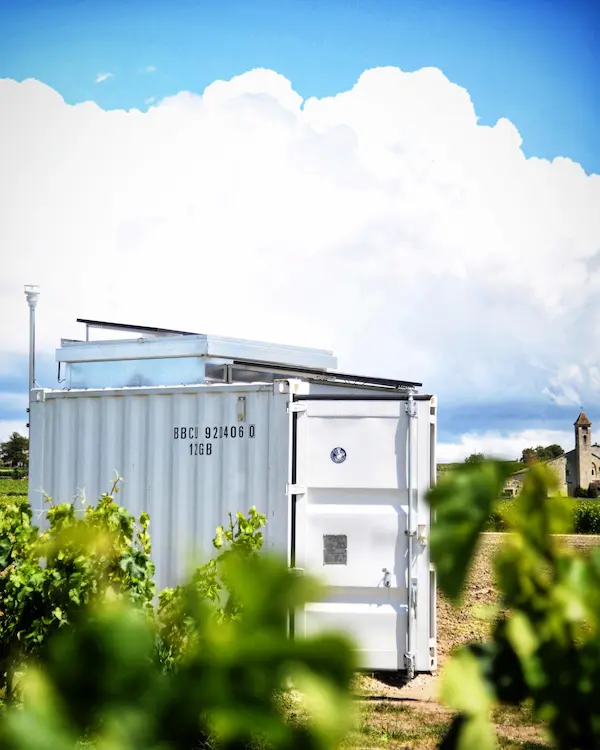
LAICO SOBLI Balloons: Use Cases
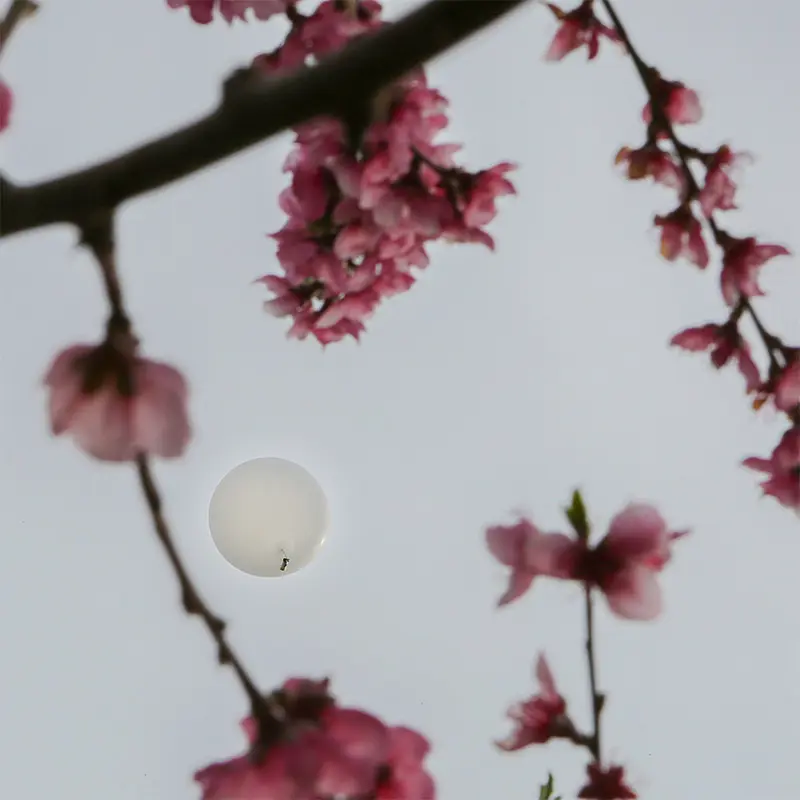
LAICO is used across every SELERYS cloud seeding program. Hail mitigation, rain enhancement, snow enhancement, and fog dispersal all rely on the same balloon, with mission parameters adjusted for each target.
Hail mitigation draws on the balloon’s fixed-site advantage: the same network of launch stations can protect a vineyard or field season after season. Rain enhancement and snow enhancement both support water supply, whether for farmland, reservoirs, or hydropower operators.
For fog dispersal programs, rather than climbing toward a cloud target overhead, the balloon releases its seeding agent at low altitude, where fog forms, and keeps reporting live atmospheric data back to CIRRUS so the operation can be adjusted as the fog bank clears.
Where LAICO Is Used
- Hail mitigation: fixed launch site protects the same territory, vineyard, or farmland year after year
- Rain enhancement: supplements water supply for farmland, reservoirs, and hydropower
- Snow enhancement: seeds cold-cloud conditions to build a fuller snowpack
- Fog dispersal: releases at low altitude, close to the ground where fog forms
Balloons vs. Drones vs. Manned Aircraft
A LAICO SOBLI network can put up to several hundred balloons in the air at once, spread across as many different locations, addressing many seedable cells at the same time. For a cloud seeding aircraft, this is impossible, because civil aviation rules prohibit flying two planes over the same area simultaneously.
Getting a manned aircraft airborne also takes longer: pilot preparation, aircraft inspection, and flight clearance take several hours, compared with LAICO Balloon’s 5 minutes. Aircraft speed is another limiting factor, because cloud seeding at 60 m/s or faster breaks the seeding agent’s particles down to a size too small to be effective. Moreover, the LAICO Balloon doesn’t need a pilot, so it carries no personal risk, even over storm cells and mountainous terrain that a manned aircraft must avoid.
| Category | LAICO | Drone | Manned Aircraft |
|---|---|---|---|
| Weather resilience | Operates through turbulence, icing, darkness, and mountainous terrain | Grounded by turbulence, icing, and darkness | Grounded by the same conditions |
| Altitude range | Any altitude, including precise low-altitude targeting | Best suited to stable, cloud layers; can work at any altitude below 5000m. | Higher altitude, limited by visibility |
| Coverage and targets | Networked launch stations, multiple targets at once across a wide territory | Networked launch stations, multiple targets at once across a wide territory, tracked with precision | One seedable cloud cell at a time (civil aviation rule) |
| Deployment speed | Under 5 minutes from the decision to launch | Minutes, but needs a pilot or operator on standby | Hours (pilot preparation, inspection, clearance) |
| Regulatory requirements | None — Full Freedom to Operate agreement | Licensed operator and flight clearance | Licensed pilot and flight clearance |
| Human supervision | None — fully autonomous from launch to ignition | Certified operator required throughout the flight | Pilot required throughout the flight |
| Environmental footprint | Biodegradable membrane disposable components are inert | Battery-powered; batteries need regular replacement | Combustion emissions from jet fuel |
Frequently Asked Questions
What is LAICO Balloon?
LAICO Balloon is SELERYS‘s patented smart cloud-seeding balloon. It launches from a SOBLI (Self-Operating Balloon Launcher Instrument) ground station via remote command and can be paired with SELERYS‘s cloud-seeding drone for high-constraint missions. SELERYS‘s design holds three international patents covering this combination of remote command, GPS-tracked flight, and optimized ignition.
What is a SOBLI station?
SOBLI stands for Self-Operating Balloon Launcher Instrument: it’s the autonomous, solar-powered ground station that checks, inflates, and launches LAICO balloons by remote command.
How many balloons can one SELERYS station launch?
Though a station technically supports up to 24 balloons, up to 6 balloons can participate in the same launch, keeping the rest in reserve for subsequent launches during the same seeding mission.
How does a LAICO cloud seeding balloon read a cloud's vertical profile?
The balloon carries radiosounding instruments; they transmit position, temperature, humidity, and pressure readings back to CIRRUS. This builds the cloud’s full vertical profile in a single ascent; an aircraft needs several passes at different altitudes to obtain the same information.
Can a LAICO network respond faster than a manned aircraft?
Yes. LAICO reaches its target (the seedable cell) in under five minutes from the decision to launch. A manned aircraft’s pre-flight checks alone typically take longer than that.
Can a LAICO smart balloon network handle more than one seedable cell at a time?
Yes. While civil aviation rules permit only one aircraft per seeding area at a time, a balloon network is not subject to that restriction and can treat multiple cells within the same window.
How much CO2 does balloon-based cloud seeding save compared to aircraft?
A standard SELERYS balloon program saves around 75 tons of CO2-equivalent a year compared with aircraft-based seeding, according to an independent survey sponsored by the European Commission.
get in touch with our team
and find the best response to your needs